Funerals Are a Guilt-Powered Ripoff and Wall Street Bought the Funeral Home
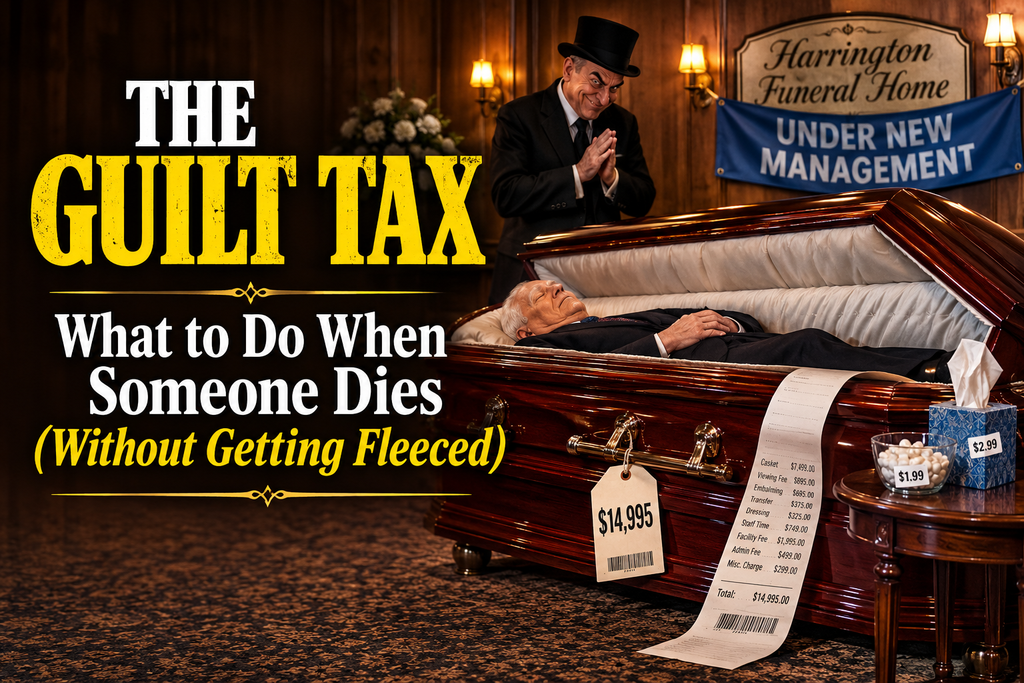
There is exactly one purchase in American life where the customer is in shock, running on two hours of sleep, staring down a deadline measured in days, and quietly convinced that asking for a discount will make Grandma sit up and slap them.
The funeral industry has spent roughly a century building a cozy, wood-paneled business model around that customer, and a new report shows the strategy is working out beautifully for everyone except the people paying.
The nonprofit Groundwork Collaborative found that the average funeral now costs almost $8,000. funeral prices have climbed 310% since 1986, and that 37% of families who paid for a funeral in 2025 went into debt to do it. Nothing honors a loved one quite like a credit card balance that outlives the grief.
And that $8k doesn’t include the cemetery plot, the headstone, or the conga line of add-ons that can shove the bill well past $15,000, most of which comes due within days, before anyone has even figured out who gets Dad’s good recliner.
Consider this your “what to do when someone dies” guide, and do yourself a favor and bookmark it now, while everyone you love is still alive and mildly annoying, because the worst possible time to learn how this racket works is in a funeral home’s arrangement room the morning after. I know this because I watched my stupid brother walk in there unprepared and walk out considerably poorer, and I’d rather not watch you do the same. So let’s take a respectful, solemn, deeply sarcastic walk through where the money goes, who’s actually pocketing it, how much of it is spent to soothe guilt rather than to honor anyone, and exactly how to make sure none of it happens to you.
Your “Family-Owned” Funeral Home Might Answer to Private Equity
Here’s the line from the report that deserves to be carved into polished granite and installed outside every funeral home in America, preferably at their expense:
Corporations and private equity-backed firms now control roughly one in five U.S. funeral homes and handle “a disproportionate share” of funerals, and as the industry consolidates, the new owners often work to squeeze out as much profit as they can.
Read that again, and then picture the warm, wood-paneled place with the founder’s name on the sign where your family has been dropping off its dead for three generations. The kindly guy in the cardigan who remembers your uncle’s favorite hymn now reports to a regional vice president, who reports to shareholders or a private equity fund that considers bereavement a growth vertical.
The biggest player, Service Corporation International runs Dignity Memorial, has a well-documented habit of buying funeral homes and leaving the original family name on the building, often keeping the former owners on as managers. The pricing, meanwhile, doesn’t stay neighborly. A 2017 Consumer Federation of America study found SCI’s funeral services averaged 47% to 72% above the local market rate, despite saving a fortune due to consolidation. Economies of scale are a wonderful thing when you’re the one who gets to pocket the savings.
Private equity took one look at that business model and started drooling. When PE-backed Foundation Partners Group bought Angel Valley Funeral Home in Tucson in 2019, the price of a cremation jumped from $425 to $760, which works out to a 79% raise for the exact same fire. Meanwhile, funeral homes that used to sell for three to five times their annual revenue started fetching seven to nine times revenue. Someone has to pay back that premium, and that someone is you, sitting in the arrangement room clutching a box of tissues and wondering whether those are marked up too.
Vermont Senator Peter Welch, who’s pushing legislation on all this, summed it up best: grieving families walk in wanting to show their love one last time, and “the up-sellers want to translate that emotion into cash for themselves.” When a sitting U.S. senator starts sounding like a consumer-advocacy YouTuber, you know an industry has truly outdone itself.
Free tip: before you sign anything, look the nice man in the eye and ask, “Who owns this funeral home?” If the answer comes with a pause, a soft smile, and a smooth pivot to the floral packages, you have your answer. If he does say he owns it, AI check him because he’s probably lying because he knows you’re still in shock.
The Guilt Engine
The arrangement meeting is a sales funnel wearing a cardigan and speaking in a hushed voice. You walk in a day or two after a death, emotionally hollowed out, and you’re asked to make a dozen expensive decisions in about an hour, with no reviews, no price comparisons, and no chance to sleep on it, since the corpse isn’t going to wait.
Comparison shopping is practically impossible by design, because the report found only 18% of funeral homes even bother to post prices on their websites, which means your local pizza place is more transparent than the people burying your father.
The structure starts with a mandatory “basic services” fee, which ran $2,495 in 2023 and is the one charge you legally can’t decline, so think of it as the cover charge for being dead. Everything after that is optional, though you’d never guess it from the way it’s presented.
Embalming alone starts around $1,000, and no state law requires routine embalming for every death, so families routinely drop four figures to make someone look “natural” for one afternoon.
Then come the viewings, the facility fees, the hearse, the “service car,” the vault, the casket, the flowers, and the programs, each one gently framed as a little referendum on how much you loved the deceased. Nobody wants to be the kid who picked the economy option for Mom, and the industry understands that way better than you do.
That’s the whole trick, and it works because guilt quietly does the closing for them without anyone ever having to deliver a hard sell. It may be the only sales job on earth where the customer upsells themselves and then sends a thank-you card.
The Plot Thickens: Pre-Buying Real Estate for Your Corpse
And then there’s the retiree special, the burial plot purchased twenty years ahead of schedule to “lock in today’s price” and “spare the kids the hassle.” It sounds responsible, and it gets pitched with all the urgency of a timeshare presentation, except the resort is a hole in the ground and checkout time is never.
To start with, you aren’t even buying land. Consumers’ Checkbook points out that a cemetery plot gets you only the right to be buried there, not ownership of the dirt, so you’re essentially prepaying rent on a very small, very permanent apartment you’ll never get to complain about.
Then life does what life does, which is mostly scramble your plans. People retire three states away, the kids scatter across the country, and a family that bought a row of side-by-side plots in 1998 decides on cremation in 2026.
Good luck getting your money back, because many cemeteries won’t buy plots back, which is why Facebook Marketplace and Craigslist are lousy with grave sites for sale, right between the used treadmills and the free couches.
The bigger gotcha is that a prepaid plot is not a paid-for burial; it’s a down payment on a bill nobody has written yet. Opening and closing the grave can run up to $2,500 for digging a hole and filling it back in, and most cemeteries require a grave liner or vault on top of that, with the NFDA’s median vault price coming in at $1,695 in 2023.
Then the consolidation monster lurches back into frame. The American Prospect told the story of a man in the D.C. area who bought burial rights at Fort Lincoln Cemetery about twenty years ago for $500 up front. The cemetery later changed hands, and SCI took it over in 2013. When he went in to finalize things in retirement, he was quoted $8,545 for the package without a memorial stone, or $12,490 with one, which pretty much demolishes the whole lock-in-today’s-price sales pitch.
And here’s the demographic kicker: the U.S. cremation rate hit a projected 63.4% in 2025, more than double the burial rate of 31.6%, and the NFDA expects cremation to reach 82.3% by 2045. A whole lot of pre-bought plots are reservations for a burial the next generation has zero intention of holding, which means a lot of retirees are paying for a space their kids are never going to visit. Checkbook’s advice is to not let a cemetery scare you into buying now with warnings that prices will become prohibitive later.
Caskets: A Luxury Sedan That Gets Buried After One Ride
The average casket costs about $2,500, gets looked at for a few hours, and then rots in a hole. It may be the priciest single-use item your family ever buys, and it doesn’t even come with a cupholder. Many funeral homes mark caskets up three to five times wholesale, with some higher. One price survey found the identical 18-gauge steel casket listed at $1,800 at one funeral home and $5,595 at another. Oh, Amazon sells caskets now.
My favorite scam upsell is the “protective” gasketed or sealed casket, lovingly marketed as keeping the elements out. Under the FTC’s Funeral Rule, funeral providers aren’t allowed to claim that any casket or embalming will preserve a body indefinitely, and the FTC itself warns that casket warranties may not be worth the extra money because no casket can stop decomposition. Wondering how you’d even know to file a warranty claim.
Here’s what the funeral cartel would rather you not know:
- You can buy a casket anywhere. Costco, Walmart, Amazon, a local woodworker, or your brother-in-law with a table saw all count. Federal law says the funeral home can’t refuse a casket or urn you bought elsewhere, can’t charge you a “handling fee” for using it, and can’t require you to be there when it’s delivered. Mention this in the arrangement room and watch the facial expressions.
- Big-box caskets are dramatically cheaper. When Checkbook checked, Walmart’s caskets ran from $955 to $3,395, and yes, you can technically order one in the same cart as your paper towels.
- Cremation doesn’t need a casket at all. No state or local law requires a casket for cremation, and funeral homes that offer cremation have to make inexpensive alternative containers available, because setting fire to a $5,000 mahogany box is a little insane.
- You can rent the casket. If you want an open-casket viewing before cremation, many funeral homes will rent you a showroom-grade casket fitted with a removable insert, usually heavy cardboard or plain wood, that holds the body and then goes straight to the crematory, so the body never touches the rental itself. It works for burials too, since you can rent the fancy model for the viewing and bury the person in something far simpler. One mortuary-equipment supplier puts rentals at roughly $595 to $1,995, compared with $2,800 to $6,500 or more to buy, though the insert is billed on top of the rental, so get both line items in writing. That same supplier says the average ceremonial casket gets reused 29 times, which means the gleaming “final resting place” at a cremation viewing may have hosted more guests than an Airbnb, and not one of them has ever left a bad review.
The Repast: Why Am I Catering Lunch for Your Cousin’s Coworker?
Then comes the after-party, where the grieving family gets to play caterer, host, and ATM all at once. Funeral catering typically runs $12 to $25 a head, which works out to roughly $700 to $2,000 for a crowd of 50 to 80 people, and the family is usually the one stuck with the bill. Half the room consists of people you have never met in your life, a few of whom you strongly suspect read the obituaries recreationally and showed up for the dried out baked ziti.
The original idea ran in the opposite direction, which makes the current setup even more absurd. The community fed the grieving family. Church bereavement committees put on the meal, neighbors showed up with casseroles, and potlucks were the norm. Somewhere along the way the whole thing got flipped upside down, and now the people who just lost someone are expected to throw a catered luncheon for a crowd of acquaintances on top of a five-figure funeral bill, like a wedding reception where the guest of honor can’t even enjoy the open bar.
Fuck that. If people want to gather and eat, they can bring a dish like civilized adults, and plenty of churches, unions, lodges, and clubs will sponsor or organize a meal for a member’s family if you ask. A grieving family is not a banquet hall, “it’s expected” is not a valid line item, and nobody has ever needed to honor Aunt Carol by putting a tray of chicken wings on a Visa.
“Remember Me”: The Ego Line Item
This is the part nobody likes to say out loud at the wake.
A lot of the lavish funeral machine runs on an expectation set years in advance by the person who died. Some expect their exit to be an Event with a capital E, complete with the plot with the nice view, the polished granite, the steel casket, the packed room, the buffet, and the slideshow set to something guaranteed to make the cousins cry. You’d think you were at Taylor Swift’s wedding.
Pre-planning gets sold as a “gift to your family,” but when what gets pre-planned is the deluxe package, it’s mostly a monument to the person in the box, with the kids left holding the balance due and a fresh helping of guilt if they dare to downgrade.
Psychologists have a name for what’s going on, terror management theory, which grew out of Ernest Becker’s book The Denial of Death. The idea is that knowing we’re going to die creates a low, constant hum of dread, and people manage it by attaching themselves to things that will outlast them. Apparently, a polished granite slab with your name on it, in a cemetery that promises “perpetual care,” is about as literal a symbol of permanence as money can buy, so what’s actually being purchased is less a hole in the ground than a receipt proving you existed.
Stack the rest of late-life psychology on top of that. Older people are steadily losing control of their health, their independence, and eventually their car keys, and picking out a final resting place is one decision nobody can take away from them. Widows and widowers keep the empty plot beside their spouse like a promise they intend to keep, and almost everyone near the end wants to feel their affairs are tied up neatly. And yes, for some folks the bigger stone in the better section is a status symbol, the same way an oversized wedding is.
The trouble is that the death-care industry figured out long ago exactly which of those anxieties to aim at. “Lock in today’s price” goes after the fear of loss, “don’t leave this to your kids” goes after the fear of being a burden, and “together forever” goes after the fear of being separated from the people you love, so the salesperson never has to invent your dread, only invoice it. The impulse is deeply human, and the markup is the part that’s predatory.
The truth is people are going to remember people for how they treated them while they were alive, not for the gauge of steel they were buried in. If you genuinely want to be remembered fondly, leave them money instead of an invoice. And don’t count on Uncle Sam to bail anyone out, because the Social Security death benefit is still a whopping $255, an amount Senator Welch notes hasn’t been adjusted in more than 70 years.
The Free(ish) Exits
That mandatory basic services fee is only unavoidable if you walk through a funeral home’s front door in the first place, and it turns out there are several side doors the cartel would prefer you didn’t notice.
1. Donate yourself to science. Whole-body donation to a medical school is sometimes free, with the program typically covering transport and cremation once the students are done figuring out where the spleen goes, and the remains generally come back to the family within six months to three years. The catch is that medical schools are picky. Programs can turn a body away for an infectious disease, organs removed for donation or surgery, serious injury, or simply being too far away, and the University of New England once sent a donor back because of her BMI.
Here in Alabama, the University of South Alabama in Mobile covers the costs once the body arrives and mails the ashes back, and the Alabama College of Osteopathic Medicine in Dothan charges nothing as long as death occurs within its service area. UAB, on the other hand, the only medical organization I personally hate for double billing me for dermatology, of course charges a $750 fee, needs the body received within 8 hours of death, and tells donors outright to keep a backup plan.
2. Let the county handle it (if you qualify, which you probably don’t). Alabama law makes every county responsible for burying unclaimed or indigent bodies at the county’s expense, though the rules vary from county to county. “Indigent” means genuinely broke, and not having life insurance doesn’t count.
3. If you served, take the free plot you earned. Most veterans can be buried in a VA national cemetery, along with their spouses and sometimes their dependent children, and the package includes opening and closing the grave, the liner, the marker, and perpetual care at no cost. That’s the exact list of things a private cemetery nickel-and-dimes you for, handed over for free. And yet of the roughly 582,000 veterans who died in 2022, only about 22% ended up in a national, state, or tribal veterans cemetery, which means an awful lot of families paid for something the government was giving away.
4. Do it yourself. Only nine states require a family to hire a funeral director for any part of the process, and Alabama isn’t one of them. A family-directed funeral, where the family handles the body and the drive to the crematory, can run a few hundred dollars instead of a five-figure funeral home bill. It isn’t for everyone, and you’ll want to check your state and county rules before you try it, but it’s a useful reminder that in most of the country a funeral home is a service you’re allowed to decline rather than a legal requirement.
How to Opt Out of the Guilt Tax
- Shop by phone. Under the FTC’s Funeral Rule, funeral homes have to give you price information over the phone, and they have to hand you an itemized General Price List if you ask in person. Make them say the numbers out loud, because it builds character.
- Ask who owns the place. Independent and corporate-owned homes in the same town can be hundreds or thousands of dollars apart, and the cute family name on the sign won’t tell you which one you’re standing in. Some will lie, so double check with your state office.
- Consider direct cremation. Cremation without a viewing or service averages roughly $1,100 to $2,200 nationally, compared with an $8,300 median for a traditional funeral with viewing and burial.
- Pick your cremation provider before anyone dies. Hospitals hold the body in the morgue, usually for a day or less, and then release it to whichever funeral home or crematory the family names, and they’re legally required to release it even if the medical bills are unpaid. If a death is expected, choose a cheap direct-cremation provider ahead of time and give its name to the hospital or hospice, so the body goes straight there instead of to whoever the hospital calls by default, because the first funeral home that shows up with a gurney is NOT a binding contract. If one beats you to it anyway, it can bill you for the pickup and refrigeration, but it can’t hold your loved one hostage until you pay. The Alabama Supreme Court settled that in 1986 in Levite Undertakers Co. v. Griggs, where a family found their relative still zipped in a body bag in the back of a hearse and was told “he ain’t goin’ nowhere” until the funeral home got its money, and the court upheld the family’s verdict, calling the conduct morally reprehensible and prohibited by Alabama statute. So have your chosen provider request the transfer, sign nothing but a release, and if anyone stalls, drop that case name along with the phone number for your state board of funeral services.
- Decline embalming unless you truly want a public viewing, since nobody needs to spend four figures on an open casket nobody asked for.
- Buy the casket or urn yourself, and don’t let anyone sneak in a handling fee, because they legally can’t charge one.
- Think twice before pre-buying a plot. If you do it anyway, get the buyback, transfer, and opening-and-closing fees in writing before you hand over a single dime.
- Make the repast a potluck, or skip it entirely and let everyone grieve on their own lunch budget.
- Put your own wishes in writing, and make them cheap ones, so your family never has to argue with a salesperson about how much they loved you.
Dying is inevitable, but getting fleeced on the way out is entirely optional, and the funeral industry is counting on you being too sad to remember that. Save this article. And I’m truly sorry for your loss.
Sources
- USA Today, “Death is driving Americans into debt” (Nov. 15, 2026), reporting on the Groundwork Collaborative report: https://www.usatoday.com/story/money/personal-finance/2026/11/15/funeral-cremation-costs-rising-inflation-debt-probate/92729380007/
- FTC, “The FTC Funeral Rule”: https://consumer.ftc.gov/articles/ftc-funeral-rule
- FTC, “Shopping for Funeral Services”: https://www.govinfo.gov/content/pkg/GOVPUB-FT-PURL-LPS104925/pdf/GOVPUB-FT-PURL-LPS104925.pdf
- Consumers’ Checkbook, “How to Save Money on a Casket”: https://www.checkbook.org/twin-cities-area/funeral-homes/articles/How-to-Save-Money-on-a-Casket-5740
- Consumers’ Checkbook, “Should You Buy a Casket Online?”: https://www.checkbook.org/washington-area/funeral-homes/articles/Should-You-Buy-a-Casket-Online-5740
- Consumers’ Checkbook, “Choosing a Cemetery”: https://www.checkbook.org/washington-area/funeral-homes/articles/Choosing-a-Cemetery-1623
- Cremation Institute, Casket Markup Calculator: https://cremationinstitute.com/death-hacks/casket-markup-calculator
- Kiplinger, “Selling a Burial Plot Is a Grave Decision”: https://www.kiplinger.com/article/retirement/T021-C000-S001-selling-a-burial-plot-is-a-grave-decision.html
- Daily Herald on unused cemetery plots for sale: https://www.dailyherald.com/?p=1339991
- The American Prospect, “Big Funeral Exploits Consumers”: https://prospect.org/power/2024-01-24-big-funeral-exploits-consumers-inflation/
- KFF Health News, “Death Is Anything but a Dying Business as Private Equity Cashes In”: https://kffhealthnews.org/aging/funeral-homes-private-equity-death-care/
- Service Corporation International (Wikipedia, citing Bloomberg Businessweek): https://en.wikipedia.org/wiki/Service_Corporation_International
- NFDA, 2025 Cremation & Burial Report: https://www.nfda.org/nfda-releases-2025-cremation-burial-report-comprehensive-insights-to-guide-the-future-of-funeral-service/
- Funeral cost statistics (NFDA 2023 General Price List Study): https://walnutinvest.com/stats/funeral-cost-statistics
- Quartz on direct cremation costs: https://qz.com/funeral-costs-increasing-how-to-manage-expenses
- CaterCow, funeral catering costs: https://blog-api.catercow.com/funeral-catering/
- Dignity Memorial, “What Is a Repast?”: https://www.dignitymemorial.com/memorial-services/funeral-traditions/what-is-a-repast
- Body donation (Wikipedia): https://en.wikipedia.org/wiki/Body_donation
- Vice, “Most Americans Are Too Fat to Donate Their Bodies to Science”: https://www.vice.com/en/article/most-americans-are-too-fat-to-donate-their-bodies-to-science
- University of Minnesota, “What Is Whole Body Donation?”: https://med.umn.edu/research/anatomy-bequest-program/what-whole-body-donation
- UAB Anatomical Donor Program: https://www.uab.edu/medicine/home/donors/anatomical-donor-program
- UAB Anatomical Donor policy statement: https://www.uab.edu/medicine/home/images/give/anatomical-donor-policy-statement.pdf
- University of South Alabama Anatomical Gifts Program: https://aesta.southalabama.edu/colleges/com/administration/how-to-donate.html
- ACOM Willed Body Program: https://www.acom.edu/?p=9159
- Mobile County, AL, Indigent Burials: https://mobilecountyal.gov/indigent-burials
- AARP, VA burial benefits: https://www.aarp.org/veterans/va-burial-benefits/
- VA burial benefits guide: https://funeralhomedirectories.com/blog/va-burial-benefits-veterans-guide
- Funeral Consumers Alliance, funeral rights: https://funerals.org/wp-content/uploads/2023/11/2023-6-9-funeral-rights.pdf
- Cremation Institute, DIY funeral: https://cremationinstitute.com/death-hacks/diy-funeral
- Funeral Basics, rental caskets: https://www.funeralbasics.org/?p=10235
- American Mortuary Coolers, casket rental options and costs: https://mymortuarycooler.com/blogs/news/an-essential-guide-to-casket-rental-options-and-services
- Everloved, what happens when someone dies in the hospital: https://everloved.com/articles/post-death-logistics/what-happens-when-someone-dies-in-the-hospital/
- Green Cremation Texas, how long a body can stay in a morgue: https://www.cremation.green/how-long-can-a-body-stay-in-a-morgue/
- Levite Undertakers Co. v. Griggs, 495 So. 2d 63 (Ala. 1986): https://law.justia.com/cases/alabama/supreme-court/1986/495-so-2d-63-1.html
- Alabama Board of Funeral Service: https://fsb.alabama.gov/consumers/