The Best Way to See Maui on a Cruise Day
I’m not going to sugarcoat this because that’s not what Admiral Tim does. If you want the truth, read on. If you want the Disney special, hit the back button now.
Every cruise ship that ties up in Kahului unloads a few hundred people who have already decided how they’re spending the day. They’re driving the Road to Hana. It’s on the bucket list. It’s in the brochure. Someone’s brother-in-law said it was the best day of his life (thirty years ago).
The Hana Highway turned 100 in 2026. National Geographic ran its centennial piece, and every travel outlet on earth is about to remind you — which means the most crowded road on Maui is already got a year’s worth of free advertising.
Here’s the thing nobody tells you: for a one-day port call, it’s a terrible choice — and it’s been the wrong choice for over 30 years. Why?
Let’s be completely honest with a fact none of the tour guides will tell you. Maui residents don’t really like tourists. So if your rental car gets broken into, you get dirty looks from locals, or you hear a bunch of kids calling you rude names you don’t understand while laughing, that’s why. I’m not saying it’s dangerous or don’t go to Maui, I’m saying be courteous, and be aware.
The math doesn’t work
The Hana Highway runs 64 miles with roughly 620 curves and 59 bridges, 46 of them one lane wide. Without stopping, it’s about two and a half hours each way. Realistically, with stops, you’re looking at nine or ten hours.
And Hana itself kind of sucks. It never really was a destination. It’s a gas station, a general store, a ballfield, and somewhere to puke. You spend an entire day getting car sick driving to a place whose entire mystique is that it’s stupid hard to reach.
The genuinely great part — the Pīpīwai Trail and its cathedral of a bamboo forest at Kīpahulu — is WAY past Hana, another hour each way. That trail is the bamboo forest everyone has seen photos of, and almost no day-tripper makes it that far. Which means most people drive five hours to experience, well, the drive. And nobody selling you this trip has ever led with that.
It isn’t a spontaneous adventure anymore
The version of this trip your brother-in-law did in the 1990s no longer exists. Waiʻānapanapa State Park, the black sand beach that’s the single best stop on the road, now requires a prepaid reservation for every non-resident, released 30 days out, with a hard rule that you arrive inside the first 30 minutes of your time slot or they will turn you away, paid or not. Popular pullouts fill before 9 a.m. Parking enforcement has ramped up considerably.
Now stack a centennial year on top of that. The fantasy of pulling over wherever it looks pretty has been gone. You are now running a scheduled appointment through a crowded rainforest, with no cell service for long stretches of the middle miles, on a road that also happens to be the only commuter route for the families who live out there.
Add windward rain — brown muddy water, closed trailheads — and a hot car full of people fighting motion sickness, and you’ve got a day that always looks a lot better in the retelling than it does in the moment. Tourists don’t want to look like jackasses back home, so they embellish their stories. You know the routine.
What to do instead
Run the island vertically instead of horizontally. Maui goes from sea level to 10,023 feet, and you can cover that whole range in a single day with every stop a short walk from a parking lot.
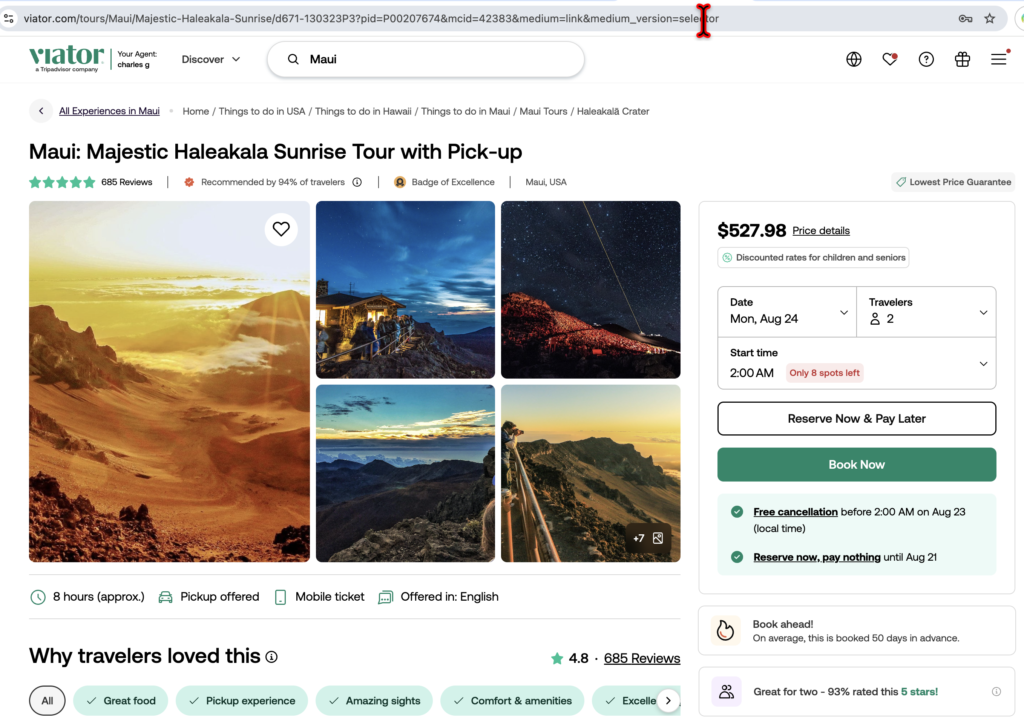
The trick is to do it minimally, and in reverse — beach in the morning, summit at sunset. Everyone else drags themselves up Haleakalā for a 3 a.m. sunrise. Sunset is nearly as spectacular, the crowds are about a third the size, and ironically sunset requires no reservations.
A one-car, one-day Maui itinerary:
| Time | Stop |
|---|---|
| 8:30 a.m. | Off the ship, rideshare to the airport, pick up the car |
| 9:45 a.m. | ʻĪao Valley State Monument (reservation required — $5/person + $10/vehicle) |
| 10:45 a.m. | Tour Wailuku old town |
| 11:45 a.m. | Hoʻokipa Beach Lookout — windsurfers and sea turtles |
| 12:30 p.m. | Have lunch in Pāʻia |
| 1:30 p.m. | Do the first ten miles of the Hana Highway so you can say you did it, turn around, and visit Twin Falls ($10 for parking) |
| 3:15 p.m. | Makawao — Upcountry paniolo town |
| 4:15 p.m. | Kula farm stands (last gas is in Pukalani) |
| 5:20 p.m. | Enter Haleakalā National Park |
| 6:00 p.m. | See the Leleiwi and Kalahaku overlooks |
| Sunset | Be at the summit 30–40 minutes early — check the time for your date, it drifts |
| 9:00 p.m. | Drop the car at the airport, rideshare back to the ship |
That mile-10 turnaround on the Hana Highway is the sleeper move. You get to marvel at a few scary one-lane bridges, Twin Falls, and a bamboo stand on the upper trail — the entire texture of the road — in about ninety minutes instead of ten freakin’ hours.
Twin Falls is at mile marker 2 on the Hana Highway, about 15–20 minutes east of Pāʻia — 6300 Hana Hwy, Haiku. It’s on Wailele Farm, private land in the Hoʻolawa Valley that the family opens to the public. The turnoff is easy to blow past. Watch for a small concrete bridge just after mile marker 2; the dirt lot is immediately on the right, and the trailhead is just left of the farm stand. Backwards, you’re coming from Pāʻia, so it’s on your right about ten minutes after you leave town.
Two things that matter for your 1:30 arrival: the farm stand posts hours of 8:00 a.m. to 3:30 p.m., so you’re fine on timing but don’t count on it if you slip late. And the lower falls sit right off the trailhead. The bamboo is up the gravel road toward the upper. And Caveman falls is roughly three quarters of a mile in with a couple of stream-only crossings. Bring water shoes.
Twin Falls is $10 per vehicle, the lot holds 55 cars and fills, and the shoulder is signed no-parking with attendants who will turn you away. Don’t leave anything valuable in the car; break-ins happen, reportedly. Although I didn’t sense any dange while we were there.
The logistics that will actually trip you up
- There is no overnight parking at the pier. We originally planned on a two-day Sixt rental, but turns out Kahului Harbor eliminated cruise passenger parking a few years ago; the space went to cargo logistics, and the rental shuttles to the harbor were discontinued around the same time. Any guide still telling you about any “designated parking lot at the pier” is out of date. Park at the airport and rideshare back. The Maui Mall Village directly across from the Kahului cruise terminal strictly prohibits overnight parking unless your vehicle is an Avis-Budget rental from the branch located inside the mall. For all other vehicles, mall security patrols the lot and can tow cars left overnight. While some cruisers gamble by parking near the 24-hour Longs Drugs and leaving a store receipt on their dash, risking a tow is an expensive hassle that will ruin a port day.
- Check what day of the week you’re in port. The off-airport rental counters near the harbor have been reported closed on weekends, lots locked and all. Call the specific branch before you build a plan around one. The Avis branch is open from 8:00 AM to 1:00 PM on Sunday, Monday, Thursday, Friday, and Saturday. The rental counter is closed on Tuesdays and Wednesdays. Rental vehicles are parked on-site right outside the office in Suite A3. Returns are handled in the same location, but you will need to plan your pick-up and drop-off carefully around their early 1:00 PM closing time.
- Dress for the Alpines at 10,000 feet. It’s routinely in the 40s at the summit with wind, and you’ll be arriving from a beach town in shorts. Pack layers in your rental or bag.
- No drones in any parks. They’re prohibited service-wide, and rangers enforce it at the summit.
- The descent is 21 miles of switchbacks — in the dark. Low gear, easy on the brakes, and watch for cattle on the upcountry stretch.
Reservations you need to book before you leave home
ʻĪao Valley State Monument — reservations are required for out-of-state visitors. Book at gostateparks.hawaii.gov/iao-valley. $5 per person plus $10 per vehicle, plus tax, released 30 days out. Park hours are 7 a.m. to 6 p.m., last slot at 4:30, and you have to be through the gate by 5. Check current alerts at dlnr.hawaii.gov first — the park has had closures for slope work.
Haleakalā National Park — no reservation needed for sunset or entry after 7 a.m. However, you will still pay $30 per vehicle at the gate, and the receipt is good for three days across both national (not state) park districts. Conditions at nps.gov/hale.
Haleakalā sunrise, if you insist — recreation.gov. $1 extra (plus the $30) per vehicle, released 60 days ahead at 7 a.m. (Hawaii time) and frequently gone in fifteen minutes. A second batch drops two days out at the same hour, which is a backdoor most people don’t know about. Sunsets don’t require the $1 fee and no reservations are required.
Waiʻānapanapa State Park, if you’re doing Hana anyway — gostateparks.hawaii.gov. Same 30-day window, same 30-minute arrival rule.
The boat to Hana? Does not exist.
Geography, mostly. Kahului is Maui’s only deep-draft commercial harbor. Hana Bay is a shallow open roadstead facing northeast — directly into the trade winds and the swell, with no reef, no breakwater, and nothing but a small pier. To get there by sea from Kahului you’d round the fully exposed north and east coast, which is rough water most of the year. The same people getting carsick on the highway would have a considerably worse time of it, and you wouldn’t save any real time.
Then the economics: Hana is about 1,200 people. There’s no traffic to support a route. The irony is that boats are how Hana used to work. Before the road, the town was supplied and reached by sea — inter-island steamers called at the Hana landing, and the wharf served the sugar plantation. The highway put an end to that, and the road’s hundredth birthday is also the hundredth anniversary of Hana’s sea link becoming obsolete.
Flying to Hana?
There’s actually scheduled airline service to Hana if you really have your heart set on seeing it but can’t handle the drive. Southern Airways Express flies Kahului to Hana, the only commercial route into HNM, at roughly 14 flights a week. It’s about a 25-minute hop covering 27 miles, with fares starting around $90. It’s a nine-seat Cessna Grand Caravan and Hana Airport is essentially a one-room pavilion — no TSA checkpoint, vending machines, and your pilot throws your bag onto the ground himself. Small-plane service on the wetter side of the island is weather-dependent by nature — so allow yourself a few days cushion.
Hana helicopter products are generally sightseeing tours, not transport. Maverick’s Hana Rainforest flight includes a 35-minute landing to explore on foot in the Wailua Valley, a former taro plantation — that’s a private clearing in the jungle, not Hana town. You don’t really end up anywhere useful.
The one that’s actually clever is the combo. Hawaii Tours runs an “Ultimate Road to Hāna” that pairs a five-hour land tour with a 35-minute helicopter flight, with the early departure driving out and flying back from Hāna Airport. That solves the single worst thing about the trip. You see the boring road once instead of twice, and you get the aerial view of all the cool stuff the road now hides.
When Hana is worth it
I’m not saying the road is bad. I’m saying it ain’t really all that great, and the 1990s pull over and gaze at everything experience you’ve prolly read or heard about doesn’t exist anymore. Plus, it is an exhaustingly long day.
If you can spend a night in Hana to break it up, wake up in Hana, then hit Kīpahulu and the Pīpīwai Trail in the morning while the day-trippers are still white-knuckling their way past Keʻanae, and then drive back at your own pace. Same goes if you’re on your third Maui trip and you’ve already done the summit, or if you’re the kind of idiot who thinks the drive is the destination. If that were the case, you may be the kind of weirdo who risks their life to climb mountains for no reason, so chances are you’re not doing Maui three times because there are more mountains to potentially die on. Hey, whatever grinds your spine, bro.
Here’s the part nobody puts in the “just stay overnight!” advice: Hana has roughly a dozen properties. There’s one real resort, the Hyatt Hana-Maui Resort, and it’s priced like the only resort in a town with no competition. Hana Kai Maui gets you an oceanfront condo with a kitchen, which matters more than it sounds — dining in Hana is a general store, a few food trucks, and the ranch restaurant. Everything else is vacation rentals, mostly ohana units (like a small mother-in-law suite).
The value play is the Waiʻānapanapa State Park cabins at $100 a night. Each cabin has its own bathroom with a shower, toilet, and small sink with a bit of counter — basic but self-contained. That’s a real advantage over the campground, which uses shared outdoor restrooms. Cabins sleep six on three sets of twin bunk beds, so privacy is nonexistent among your party. And essentially nothing is provided — bring your own linens, towels, dishes, cookware, and utensils. One guest noted the only soap in the cabin is dish soap, and there’s no coffee maker, which is a rough discovery at 6 a.m. ten minutes from town. Your cabin booking doubles as your park entry, so you skip the timed day-use reservation and get the black sand beach to yourself at sunrise. The catch is that they reportedly vanish within minutes of release at midnight Hawaii time, with a two-night minimum.
Note that lodging and day-use are now two different systems: camping and cabins run through explore.ehawaii.gov, day-use entry through gostateparks.hawaii.gov. Confirm the booking window on the site — the guides don’t agree, and that includes this one.
Book it a month out and go. But if the ship leaves at six and you get one shot at this island, go up instead of out.
One more note for anyone heading to West Maui: Front Street in Lahaina reopened to traffic in August 2026, nearly three years after the wildfires, with a small number of other businesses back in operation. Much of the historic core is still active construction rather than a finished district, so go with the right expectations — and spend money there. It matters more in that part of the island than almost anywhere else in the state.