Kauai has a geography problem. It’s the oldest of the main Hawaiian chain — about five million years of rain and erosion chewing on volcanic rock, fed by one of the wettest places on Earth. The result is magnificent and almost entirely off-limits. There is no road around Kauai. The highway runs up the east side, hits the north shore, and quits at Keʻe. It runs down the west side and quits at Polihale. In between sits sixteen miles of coastline with no road, no houses, no power lines, and no way in that doesn’t involve a boat, a helicopter, or a permit and a very muddy day. Roughly two-thirds of this island cannot be driven to at all.
Hold onto that, because it’s the answer to nearly every question you’re about to have. Why does a fifty-five-minute flight cost four hundred dollars? Because you can’t get there. Why is the good stuff never included? Because you can’t get there. Why does a two-day port call feel like a series of small betrayals? Same reason.
Here’s what’s worth seeing, what it takes, and — the part most guides skip — what we passed on and why.
The Three That Actually Matter
Waimea Canyon and Kokeʻe
Ten miles long, a mile wide, three thousand feet deep. Everyone calls it the Grand Canyon of the Pacific, which undersells it, because I’ve seen the Grand Canyon and it doesn’t have jungle growing in it.
It’s about an hour and fifteen from Lihue, uphill and winding. Go in the morning. Clouds build all day, and by afternoon the whole thing can be a gray suggestion of a canyon while you stand at a railing photographing raindrops.
Now the part your tour operator would rather you didn’t know: the main Waimea Canyon Lookout is not the end of the road. Twenty more minutes up into Kokeʻe gets you the Kalalau Lookout and Puʻu o Kila, which stare down into a Napali valley from four thousand feet. Different view, better view, costs nothing extra. Plenty of bus tours stop at the first lookout, let everyone take the same photograph, and turn the coach around, because that’s twenty minutes they’d rather have back.
Ask before you book. Ask specifically. “Do you go up to Kalalau Lookout?” is a yes-or-no question, and watching someone convert it into a paragraph tells you everything.
Also: bring a layer. The rim is cold and windy and people show up in swim trunks like the island owes them a temperature.
The Napali Coast
The famous one. What makes it different from every other dramatic Hawaiian cliff isn’t height — Molokai’s are taller and nobody’s selling you a catamaran ticket for those. It’s the fluting. Erosion has pleated the cliffs into vertical folds, ridge after ridge, hanging valleys cut between them, repeating for sixteen miles. And it’s empty. After a week of Hawaii coastline filled with resorts, cane roads, and time-share pitches, Napali is the only stretch with nothing on it at all.
There’s a wrinkle underneath, too. Kalalau and Nualolo Kai were farmed and lived in — the terraces are still there — into the last century. So it isn’t pristine wilderness. It’s abandoned. Which, if you’re paying attention, is the more interesting thing to look at.
What sucks is it’s really hard to see, and especially with the limited time a cruise gives you. There are only three ways in:
Morning boat. Catamarans out of Port Allen take about five hours and run around $260. Summer flattens the north swell, so some smaller boats can actually get into the sea caves and stop to snorkel. The snorkeling is OK. Remember, you’re not there for the snorkeling.
Sunset boat. Same harbor, three and a half to four and a half hours, similar money, catered dinner, zero snorkeling. You’re trading cave access for gold-hour light on a west-facing wall of rock. Bragging rights, I suppose.
Air. Helicopters out of Lihue, 45 to 65 minutes, $200 to $450 depending on the aircraft and whether they take the doors off. Only option that also delivers Waiʻaleʻale’s crater and Manawaiopuna Falls — the Jurassic Park waterfall — neither of which has a road within miles. There’s also a fixed-wing airplane tour out of Lihue for around $149, bubble windows, no middle seat. It can’t hover into a valley, but it covers the same map for a third of the money. To be honest, no one has ever come home from a helicopter tour saying “worth every penny of that additional $250 for the hovering.” I did a plane tour in 2006 and it was just peachy.
Two things nobody puts in the brochure. If you’re filming, doors-off is the wrong purchase. Most operators make you leave behind anything that could blow away, which is a polite way of saying no GoPro, no mounts, no camera you like. Doors-on glass or the fixed-wing is the better platform. And… let’s be real. Kauai has had fatal air-tour crashes, including one near this coast in 2019 that killed seven, and the NTSB has been leaning on the FAA about Hawaii air tours for years. Operators differ in fleet age, maintenance, and in how disciplined they are about weather minimums. Asking about that is not rude. It’s the single most useful question of your life.
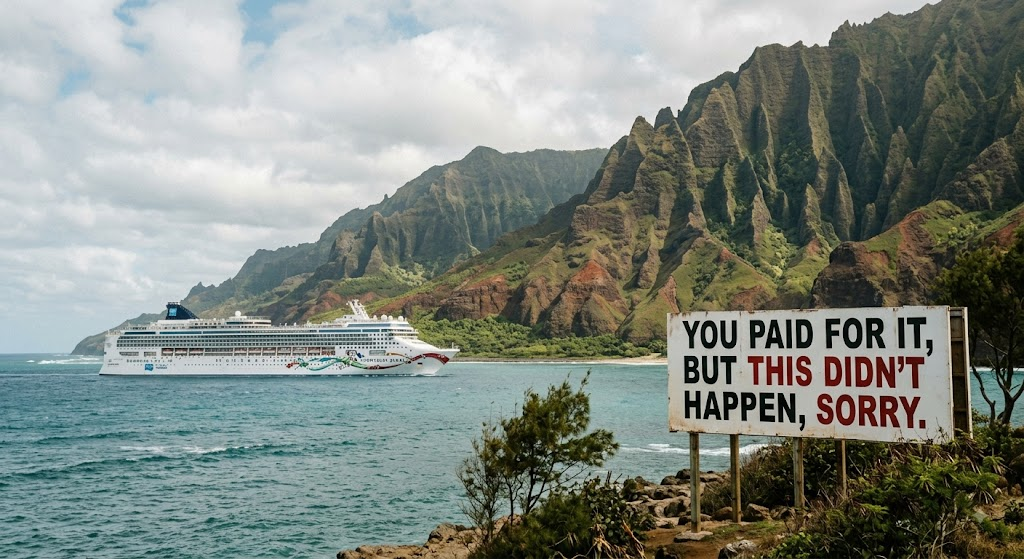
And a special note for my fellow cruisers: NCL used to sail past the Napali coast on the way out of Kauai. Three thousand people on deck, the ship making the left turn out of Nawiliwili, an hour of the best scenery of the week, included in the fare you already paid. NCL killed it for a while (dick move), but by the time you read this, it may be back. Some sources said passengers preferred skipping the Napali pass-by in exchange for three extra hours of boring Kauai port time. Bloody idiots.
The North Shore
Hanalei Bay, the taro fields, Kilauea Lighthouse, Tunnels, Keʻe. The postcard. Also an hour and a half each way from Lihue, most of it inching through Kapaʻa behind someone who has never seen a green light before. You’d spend three hours in a vehicle to spend ninety minutes in paradise. Math is math.
One trap: Hāʻena State Park — which covers Keʻe and the Kalalau trailhead — requires an advance entry and parking reservation, and they sell out. You cannot simply drive up. People try. People then drive back.
If You Have Several Days
Definitely shoot for all of the above, unhurried, plus:
- The Kalalau Trail to Hanakapiʻai Beach. Two miles in, two miles back, steep and gloriously muddy, and the best hike on the island that doesn’t need a permit. (All eleven miles to Kalalau does, and good luck.) Do not swim at Hanakapiʻai. The sign counting the dead is not decorative.
- The South Shore — Spouting Horn, Old Koloa Town, the Poipu beaches. Twenty-five minutes from Lihue and the most reliable sun on the island when the north end is being rained into a swamp.
- Polihale. End of the road, long rough dirt track, and a beach looking straight up at Napali from sea level. Four-wheel drive advisable and most rental contracts forbid the road entirely, which should tell you both how good it is and how the towing industry feels about it.
- Kilauea Point National Wildlife Refuge — seabirds, nēnē, spectacular lighthouse. Note that entering the refuge and standing at the free overlook are two different products, and any tour promising “Kilauea Lighthouse” is probably selling you the second while pricing the first.
- Hanapepe on a Friday evening for art night. The swinging bridge whenever.
- Wailua Falls, ʻŌpaekaʻa Falls, the Sleeping Giant — all close to Lihue, all short, all firmly in the “nice” tier rather than the “tell your grandchildren” tier. ʻŌpaekaʻa is viewed from a platform set so far back you’ll want a zoom lens and a forgiving attitude.
- Kauai Coffee and Kilohana Plantation for the agricultural history, which is genuinely more interesting than it sounds and comes with rum.
The Cruise Port Version
Ships dock at Nawiliwili, ten minutes from Lihue Airport. On the Honolulu round-trip, Kauai is your overnight — in Thursday morning, out Friday afternoon or early evening. Verify your departure time in your own documents. Published sources disagree by three hours, which is the difference between “relaxed morning boat tour” and “watching your ship leave.”
The overnight is the actual gift here. Thursday has no all-aboard breathing down your neck, and a weather cancellation Thursday doesn’t cost you the island. So go big and far on Thursday, and stay close on Friday. Or do nothing at all and own the ship on Friday, which is an underrated luxury while everyone else is spending four hundred dollars an hour.
Nawiliwili is also a genuinely good walk-off port, which is rare. Kalapaki Beach is ten minutes on foot. So are several very good breakfast spots, a couple of bars with live music and mostly friendly locals, and a shopping center that’ll let you leave a rental car overnight for about twenty clams.
A mile and a half out, still walkable if you’re willing: the Menehune Fishpond overlook — hand-built Hawaiian aquaculture older than European contact, and free, which in this economy feels like a clerical error. The Kauaʻi Museum is also walkable and a good choice for a rainy day. Ninini Point Lighthouse is just past the golf course. And Hamura Saimin, the local noodle counter, cash only, where the lilikoi pie outranks the noodles, and the noodles are damn good.
Car rentals are limited but available. Or use Turo and have it dropped at the pier. Rideshare is fine in the Lihue–Kapaʻa corridor, but it’s a literal coin flip on the west and north sides. You can absolutely get to Port Allen, but actually getting someone to show up to take you back can be a challenge. Taxis run roughly double and have a reputation for treating your reservation as a suggestion. A bus exists, but the bus is not really for you.
What We Skipped, and Why
The Nāpali Coast. All of it. Yep, we passed on the headline attraction. The sunset sail collided with a tour we’d already booked, plus 4 hours on a small boat facing potentially rough seas doesn’t sound heavenly. The morning snorkel meant renting a car for two days to use for one morning, on a five-hour boat, with real odds that weather smears the coast into gray felt with no chance to rebook. The helicopter is four hundred dollars for fifty-five minutes. Although they’re all pricey, none of those is really a rip-off. For us, they all seemed like a worse deal than keeping the morning and our money. If you take one thing from this post: skipping Napali is defensible, and anyone who tells you the trip is ruined without it is probably some douchebag with a boat.
The movie-locations tour. Kauai has been in a lot of films and there is, inevitably, a six-and-a-half-hour excursion about it. A participant’s own account: six hours of driving, five stops of a few minutes each, and film clips (mostly from movies made before we were born – and we’re 60) playing on a screen inside the van between them. So, basically, you’re paying to watch a monitor while the actual island — the one in the movies — goes past the window. The marquee Jurassic Park location isn’t road-accessible at all, and several other sites are on private ranch land you squint at from a shoulder. Now that shit is a rip-off.
A standalone Fern Grotto trip. It’s a real lava amphitheater with ferns growing out of the ceiling, and the riverboat up the Wailua is pleasant in the way that all riverboats are pleasant. But this was a big deal in the 1960s. The ferns have thinned substantially, and the infrastructure has been quietly aging since the Carter administration. Plus, the state now stacks a per-car parking fee and a per-person entry fee on top of the ticket for a state park you’re already paying a private operator to take you into. It is now a nostalgia act being sold at current-year prices. Bundled inside a bigger tour? Fine, enjoy the singing, it’s just lovely. I guess. But on its own, absolutely skippable.
The luau. The Smith family operation in Wailua is the biggest luau on the island. TripAdvisor reviews are moderate, but it sits at 4.7 stars across more than three thousand Google reviews. The thing is, when you start reading some of those reviews, you’ll realize it was amateur night at the review bar. You really need to weed through the one line “great” and “awesome” reviews to find the truth (i.e. people who don’t live in trailer parks and have actually been to another luau). Only then you’ll find the drinks seem sweeter than they should be and food may not have been as Michelin Star-worthy as reported. The Smith Luau is a fourth-generation family business on thirty acres of garden that includes Filipino and Japanese dances alongside the traditional, expected Polynesian ones. Some call that diluted, but who knows. We didn’t skip it because it’s a bad luau. We skipped it on opportunity cost: it’s twenty minutes each way and it eats the one evening you could instead walk off the ship and be eating better food while holding a less sugary drink in ten minutes.
There is a thing the commercial luau industry does, and it deserves a mention. The imu ceremony, where an entire pig is cooked in the ground, is the emotional centerpiece of the evening. It is also, at this luau, as it is at most venues, theater. One pig can’t feed four hundred hungry Haoles, and there isn’t time to bone and shred it between the ceremony and the buffet line. So the kalua pork on your plate may be Costco pork cooked in an oven by someone not in costume.
The Short Version
One day: Waimea Canyon, and go past the first lookout like your guide doesn’t want you to.
Two days: the canyon, plus Napali by boat or air if the budget and the schedule both cooperate. No guilt if they don’t.
A week: all of it, plus the Kalalau Trail, and for the love of everything don’t spend it driving.
And whatever your brochure says about sailing past the Napali coast on the way out — check that it’s still happening before you count on it. Some promises get quietly retired and left up on the website anyway, and I’d hate for you to find out on deck.