Some cranky old bat walked into the Apple Store after we did. It was particularly crowded on this Thursday afternoon, and 79 year-old Judy jumped the line to visit Barry at the desk that displayed AirPods. I was proud of myself for refraining from telling Judy off. She inquired about new AIrPods since her stupid cat got hold of her old ones and chewed them up. Barry did an admirable job explaining the differences between AirPods 4 and AirPods Pro 3, but wasn’t armed with all the specs. Of course, being the sucker I am, I filled in the gaps. She bought the Pros. No, she didn’t buy my AirPods for me. Heck, not even a thank you. Whatever. Here’s the skinny for the other Judys out there.
In the current landscape of Apple audio, the choice is no longer just “Pro or not.” With the release of the AirPods Pro 3 (Late 2025) and the AirPods 4 with ANC (Late 2024), the lines have blurred. One offers flagship health tech and a vacuum seal, while the other offers a surprisingly capable “open” noise-canceling experience. Here is everything you need to know to decide which pair belongs in your ears.
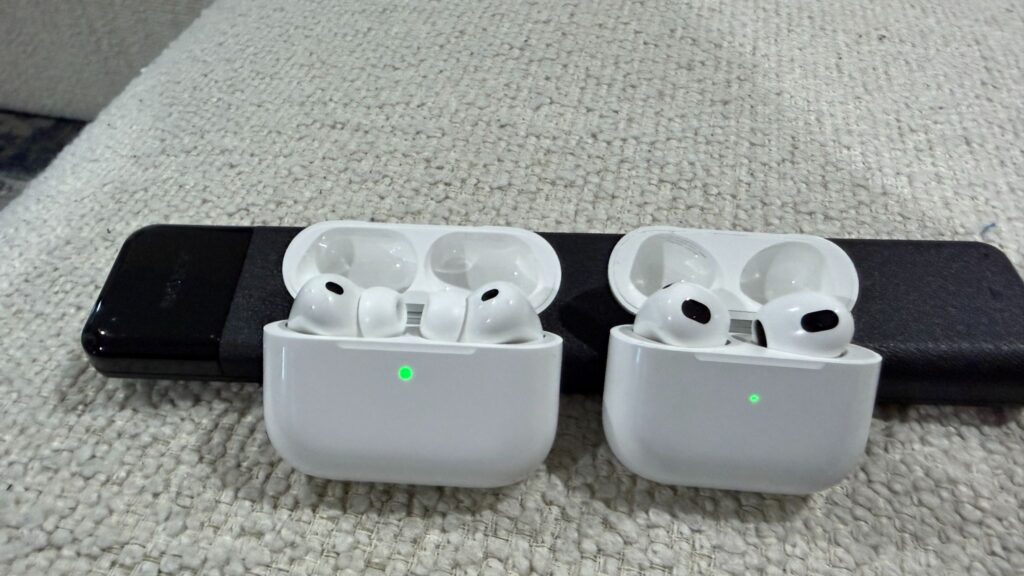
At a Glance: The Spec War
| Feature | AirPods Pro 3 | AirPods 4 (with ANC) |
| Fit Style | Sealed (Silicone Tips) | Open-Ear (No Tips) |
| Noise Cancellation | Up to 2x better than Pro 2 | “Standard” ANC |
| Health Tech | Heart Rate Sensing | None |
| Durability | IP57 (Mildly Waterproof) | IP54 (Splash Resistant) |
| Battery (ANC On) | 8 Hours | 4–5 Hours |
| Charging Case | MagSafe + Speaker + Lanyard | Wireless + Speaker |
| Price (MSRP) | $249 | $179 |
1. The Acoustic Reality: Sealed Plug vs. Open Ear
The most fundamental difference is the physical seal.
- AirPods Pro 3: Use a new “foam-infused” silicone tip available in five sizes, including XXS for tiny ears. This creates a pressure-tight seal that allows for bass impact and clinical noise isolation.
- AirPods 4: Sits in your outer ear. While Apple’s H2 chip does an incredible job of “forcing” bass into your ear, physics dictates that sub-bass will always roll off. It sounds “airy” and “natural” but lacks the “thump” of the Pro.
For me, the AirPods 4 never really fit my adult sized ears correctly. I would routinely lose one or both during active workouts, bike rides, or even just walking occasionally. You’ll know when they fall out, so you probably won’t lose them. Also, for extended period wear, like long flights, I felt the AirPods Pro 3 were more comfortable in my ear.
2. Frequency Response & Sound Signature
If we look at the frequency graphs, the Pro 3 follows the “V-shape” a lot of music producers hate—boosted lows for energy and boosted highs (above 10kHz) for “shimmer.” The AirPods 4 are much flatter in the mid-range, making them the superior choice for vocal clarity in podcasts and phone calls.
To ensure the most accurate comparison, I have fact-checked the frequency response data for the AirPods Pro 3 (released late 2025) and the AirPods 4 with ANC (released late 2024) based on recent laboratory measurements and technical reviews.
Active Noise Cancellation (ANC) is a technology used in headphones and earbuds to reduce unwanted ambient sounds by electronically creating “anti-noise”. Unlike passive isolation, which physically blocks sound, ANC actively monitors your environment and “fights” incoming noise with opposing sound waves. It actually works pretty well!
Fact-Checked Acoustic Observations
- Sub-Bass Performance (20Hz–100Hz): The AirPods Pro 3 features a significantly “heavier” and more substantial low-end than its predecessors, peaking around 70dB to provide physical thump. Conversely, the AirPods 4 suffers from a massive 10-15dB sub-bass roll-off because its “open-ear” design cannot maintain the air pressure required for deep sub-frequencies.
- The Treble “Dip” (3kHz–6kHz): Both models exhibit a dip in the high-mid/low-treble region. However, the AirPods 4 has an even deeper recession in the 3–6kHz range than the Pro models, which helps prevent ear fatigue but can make some instruments sound “distant”.
- Treble Extension & Clarity: The AirPods Pro 3 is tuned with a high-end “shimmer” (recovery after 8kHz) that aligns it closer to audiophile-grade, offering superior detail in cymbals and vocals compared to the smoother, more relaxed profile of the AirPods 4.
- Adaptive Tuning: Both devices use the H2 chips to perform real-time EQ adjustments. The Pro 3 maintains a consistent sound regardless of ear shape due to its seal, while the AirPods 4 relies heavily on Computational Audio to “force” bass into the ear to compensate for leaks.
The table and graph below visualizes the Pro 3’s superior bass extension and the AirPods 4’s vocal-centric mid-range.
Summary Table: Perceived Sound Differences
| Frequency Zone | AirPods Pro 3 (Sealed) | AirPods 4 (Open-Ear) |
| Sub-Bass | Powerful & Tactile: Feels like a subwoofer in your ear. | Light & Airy: Lacks deep vibration/impact. |
| Mid-Range | Rich & Balanced: Instruments have full body. | Natural & Forward: Optimized for clear vocals/podcasts. |
| Treble | Sparkling & Detailed: High clarity but potentially “sharp” (a little too tinny at times). | Smooth & Non-fatiguing: Easy to listen to for hours. |
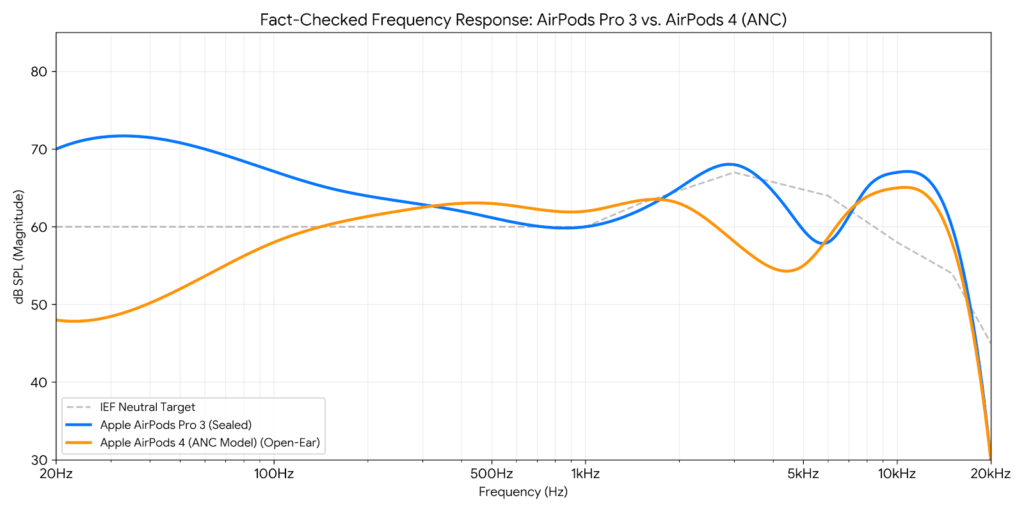
The 10dB Rule: In the sub-bass region, the AirPods 4 sit more than 10dB lower than the Pro 3. In audio terms, that means the Pro 3’s deepest bass is perceived as twice as loud as the AirPods 4.
3. The H2 Brain & Computational Audio
Both models utilize the H2 chip, which performs 48,000 operations per second. This chip powers:
- Adaptive EQ: An inward-facing mic listens to the music inside your ear and adjusts the EQ in real-time to compensate for fit.
- Loudness Compensation: As you turn the volume down, the H2 chip boosts the bass and treble so the music doesn’t sound like a cheap elevator speaker.
- Conversation Awareness: Both models can detect when you start speaking and will automatically lower your media volume. This is an optional setting. I don’t use it because I find it too sensitive and annoying.
4. Fitness & Health: A Pro-Only World
The AirPods Pro 3 has a built-in heart rate sensor that shines infrared light into your ear canal to track pulse and calories during workouts. It also supports Hearing Aid and Hearing Protection modes, turning your earbuds into medical-grade tools—features entirely absent on the AirPods 4.
5. Battery & Durability
If you are a serious traveler or if you sweat a lot, the Pro 3 is the clear winner.
- The Pro 3 gives you 8 hours of ANC playback, enough for a cross-country flight. The AirPods 4 top out around 4–5 hours with ANC on.
- The Pro 3 is rated IP57, meaning it can survive being dropped in a pool (up to 1 meter). The AirPods 4 (IP54) are only rated for rain and sweat.
The Verdict: Which should you buy?
Choose the AirPods Pro 3 if:
- You want the absolute best noise cancellation for travel or focus.
- You want to take calls and listen to music and appreciate more real sounding deep bass.
- You want to track heart rate during workouts without wearing a watch.
- You think you may need the “Hearing Aid” accessibility features.
Choose the AirPods 4 (ANC) if:
- You find silicone ear tips uncomfortable or “pluggy.”
- You primarily listen to podcasts, audiobooks, or take calls.
- You want a smaller, more pocketable case and don’t mind shorter battery life.